

Beer can leave the packaging line looking bright yet develop haze later, particularly when exposed to low temperatures during storage or distribution. What begins as a reversible haze can gradually become permanent, turning a visual issue into a stability problem. The challenge is understanding why the haze forms in the first place.
What Actually Causes Chill Haze?
Chill haze is primarily linked to an interaction between polyphenols and specific beer proteins. During cold storage, polyphenols can form hydrogen bonds with proline-rich regions of certain polypeptides. These interactions create protein-polyphenol complexes that scatter light and produce the characteristic haze. Initially, the haze can disappear when the beer warms up, but over time the interactions can become stronger and the haze can become permanent. This points to a specific opportunity: instead of removing haze after it develops, reduce the beer’s ability to form it in the first place. That is the principle behind targeted enzymatic stabilization.
Target the Haze Sensitive Protein, Not the Beer
BREWERS CLAREX® HC uses a highly specific fungal endopeptidase that acts on haze-sensitive, proline-rich polypeptides. Rather than broadly breaking down beer proteins, the enzyme targets sites associated with haze formation. This specificity matters because protein contributes to important characteristics, including foam and overall beer quality. The objective is therefore not extensive protein removal, but selective modification of the fraction that contributes to instability — intervening at the mechanism that creates the problem.
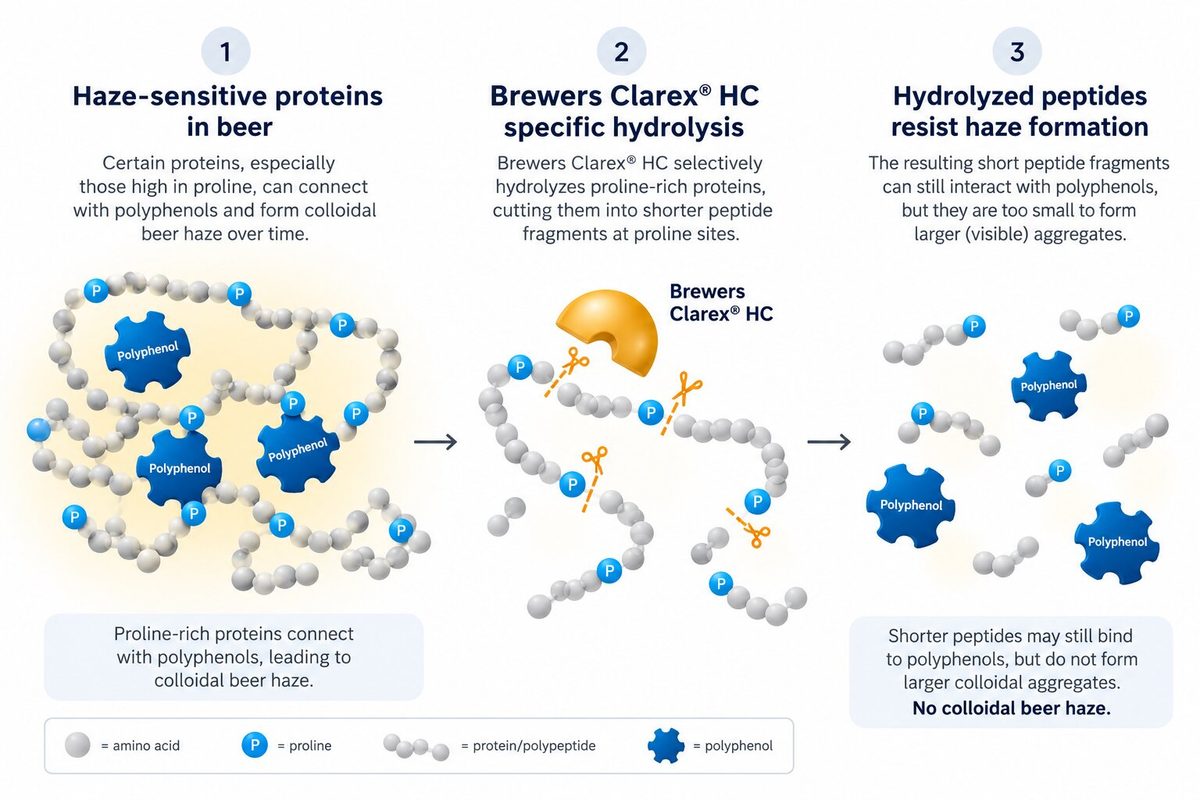
The timing of the intervention is equally important. The enzyme is introduced into cooled wort at the beginning of fermentation and can be added after cooling, after aeration or after yeast pitching under the recommended process conditions. During fermentation, the technical documentation states that it does not react with yeast or affect the fermentation profile. As fermentation progresses, it acts on the haze-sensitive polypeptides, with the stabilizing action considered complete once attenuation is reached. Because the relevant proteins have already been hydrolyzed, the application documentation states that deep cooling to sub-zero temperatures specifically to generate chill haze is not necessary. Stabilization can therefore become part of an existing process stage rather than a separate downstream operation.
Less Dependence on Refrigeration
Cold conditioning plays an important role in beer production, but maintaining very low temperatures also adds refrigeration demand and extends the overall production cycle. By addressing haze-sensitive proteins earlier during fermentation, enzymatic stabilization can reduce the need for prolonged deep cooling and allow maturation to take place at a higher temperature.
This can have two direct process advantages: lower cooling-related energy consumption and reduced Total Production Time (TPT). When the beer reaches the required stability with less dependence on extended low-temperature conditioning, time spent in maturation and deep cooling can be reduced, allowing the beer to move through the production cycle faster. The exact temperature, maturation period and resulting TPT will depend on the beer and process configuration, but the principle remains the same — achieve stability with less intensive cooling.
From Stability to Process Efficiency & Capacity Enhancement
The benefit of reducing cooling requirements does not stop at temperature control. Shorter maturation and reduced deep-cooling requirements can create additional capacity within the same production infrastructure, while lower refrigeration demand can contribute to energy savings. This makes enzymatic stabilization more than a solution for managing chill haze. By addressing the haze-forming mechanism during fermentation, breweries can potentially reduce Total Production Time, lower energy consumption and improve overall process efficiency, while maintaining the desired beer stability.
A More Efficient & Sustainable Approach to Beer Stability
For chill haze, the shift is from a reactive approach — remove the haze later — to a preventive one: identify the haze-forming proteins, target them during fermentation and reduce the need for intensive cooling downstream. When stability is built into the process at an earlier stage, breweries can reduce their dependence on extended low-temperature conditioning. The result is a more efficient process where less cooling can mean lower energy demand, shorter Total Production Time and greater process capacity. That is where beer stabilization moves beyond quality control — and becomes a part of production efficiency and sustainability.
Product Disclaimer: Brewers Clarex® HC is a product of dsm-firmenich. The product is distributed in India by The Catalysts Group, as an authorized channel partner.