 info@thecatalystsgroup.com


 GET IN TOUCH
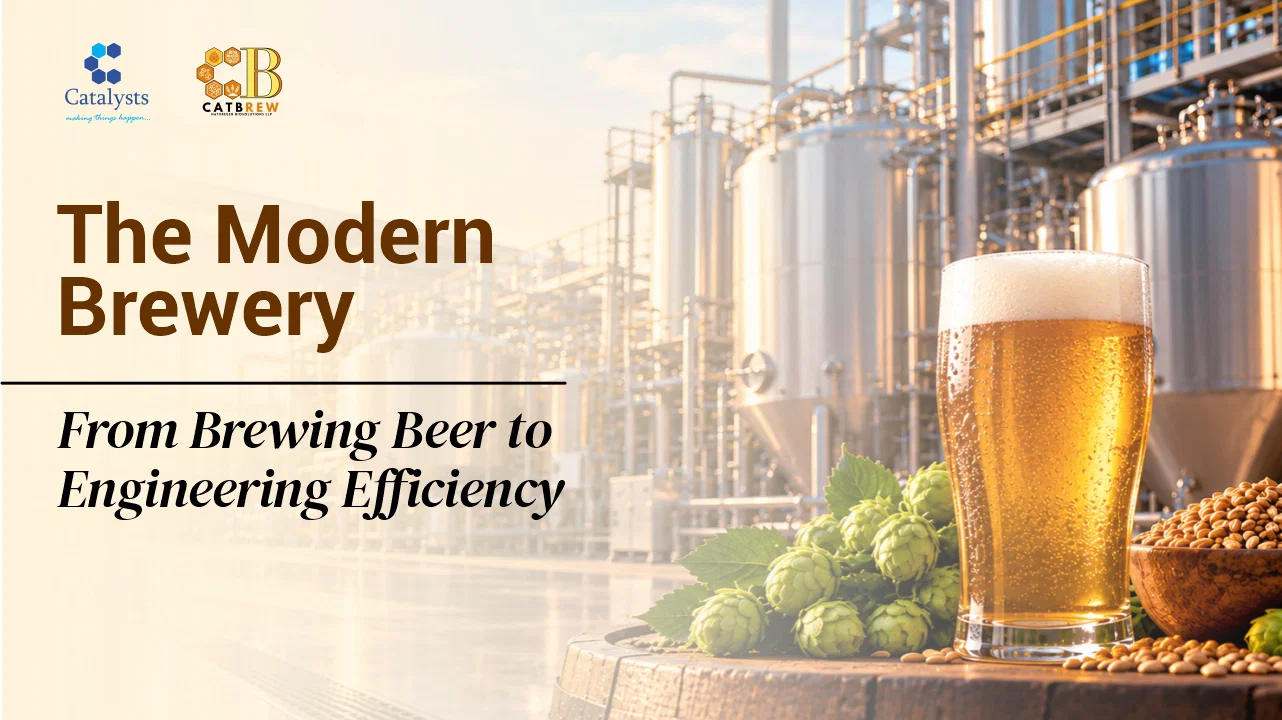
Brewing has always brought together science, craftsmanship and experience. Malt, water, hops and yeast move through a carefully controlled series of processes to create what consumers ultimately experience as a glass of beer. Yet behind that seemingly simple product is a highly interconnected manufacturing system, where raw-material quality, process conditions, fermentation performance, filtration, energy consumption, water use and production time can all influence the final outcome. As the brewing industry becomes increasingly competitive, breweries are being asked to achieve more than simply producing good beer. They need to maintain consistent quality while improving process efficiency, optimizing resources, controlling costs and responding to changing raw materials and production requirements. This is changing the way modern brewing needs to be approached. The question is no longer only how to make great beer, but how to make great beer more consistently, efficiently and sustainably.
Looking at the Brewery as a Complete System
One of the most important shifts in modern brewing is moving from optimizing individual process steps to understanding the brewery as an interconnected system. Mashing influences wort characteristics and fermentation performance, while fermentation affects maturation and filtration. In turn, filtration efficiency can influence tank turnaround, production scheduling and overall brewery capacity. This interdependence also means that a problem at one stage may originate much earlier in the process. A filtration challenge, for example, could be linked to raw-material characteristics, mash conditions, wort composition or viscosity. Addressing only the visible symptom may offer a temporary fix without improving overall performance. This is why root-cause analysis and end-to-end process optimization are essential to understanding and improving the wider brewing system.
Technology Should Start With the Process Challenge
The growing use of brewing enzymes, specialized yeast, processing aids and analytical technologies gives breweries more tools to improve performance. But technology creates value only when it addresses a clearly defined process requirement. Enzyme technology in brewing, for instance, can support starch conversion, viscosity management, extract recovery, wort processing and filtration, while also providing greater flexibility with different raw materials. However, the starting point should not be the product—it should be the process challenge. Before adopting a new technology, breweries should define the problem, establish measurable parameters and evaluate performance under actual brewing conditions. A successful technical trial should demonstrate not only technical effectiveness, but also measurable and commercially sustainable value at plant scale. The question, therefore, should move from “Which product should we use?” to “Which process challenge are we trying to solve?” This is the foundation of meaningful brewing process optimization.
The Value of Time, Efficiency and Sustainability
When breweries evaluate process improvements, cost is often the first consideration, but time can be equally valuable. Reducing brewhouse, fermentation or filtration cycle times can improve equipment utilization, tank availability and production planning, while better fermentation performance and filtration efficiency can support faster turnaround.
The same approach applies to sustainability. Better extract recovery, lower energy and water use, and reduced losses can improve both resource efficiency and operational performance. Before adopting a new enzyme, yeast, processing aid or analytical technology, breweries should consider the problem being solved, how the improvement will be measured, its economic benefit, plant-scale consistency and its impact on the overall process.
Ultimately, the right brewing technology should deliver measurable value through process optimization, efficiency and resource utilization—not simply improve one individual step.
Engineering the Brewery of Tomorrow
The brewery of tomorrow will not necessarily be the one using the most technology, but the one that understands where technology can create meaningful value and how different process improvements work together. Achieving this requires a combination of brewing expertise, process data, analytical insight and practical technology, along with an understanding of how decisions at one stage can influence the wider brewing system. Technology should not replace the brewer’s experience and craftsmanship; it should provide better tools to make informed decisions, improve consistency and use resources more effectively.
The future of brewing excellence is therefore not simply about producing more beer, but about engineering the brewing process for consistent quality, higher efficiency, better resource utilization and sustainable commercial value. At CatBrew, we work with breweries and fermentation-based industries to address these challenges through technical expertise, fermentation solutions and enzyme-based technologies. Whether the objective is improving raw-material utilization, process efficiency, fermentation performance or filtration, the focus remains on understanding the process and identifying where the right technical solution can create measurable value. Because better brewing begins with understanding the process—and knowing where the right technology can make a difference.