info@thecatalystsgroup.com


 GET IN TOUCH
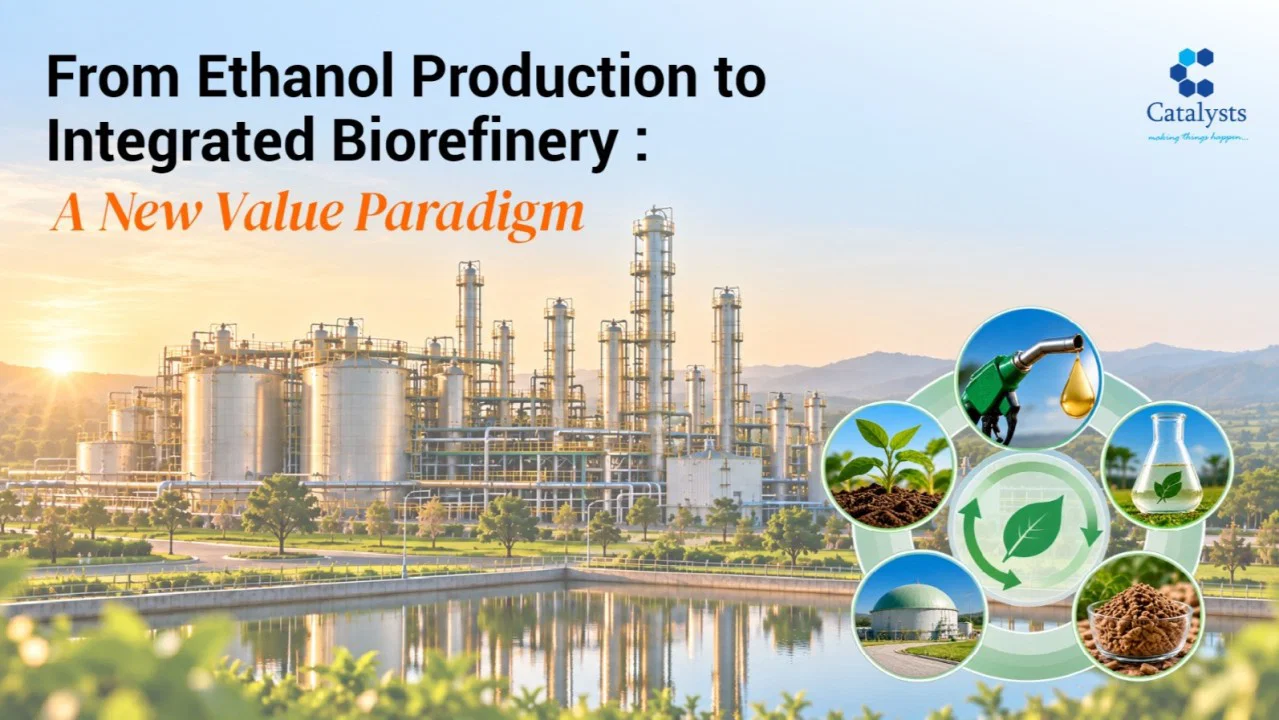
India’s ethanol industry has moved from being a predominantly sugar-industry by-product business to becoming an important part of the country’s energy and agricultural economy. India is now the world’s third-largest ethanol producer, behind the United States and Brazil, with its fuel-ethanol production growing at an estimated ~37% CAGR between 2020 and 2025, compared with around 4% globally over the same period. Ethanol production capacity in India reached about 1,953 crore litres as of October 2025, comprising approximately 980 crore litres of grain-based capacity and 973 crore litres from molasses and dual-feed distilleries. Over 2014-15 to 2024-25, sugar mills earned more than ₹1.29 lakh crore from ethanol sales, while the ethanol blending programme has also generated more than ₹1.44 lakh crore in foreign-exchange savings through reduced crude-oil dependence. With India having achieved 20% ethanol blending, the next question for distillery operators is increasingly different: how much more value can be extracted from the biomass, energy and process streams already entering the plant?
Connecting Feedstocks, Pathways and Value Streams
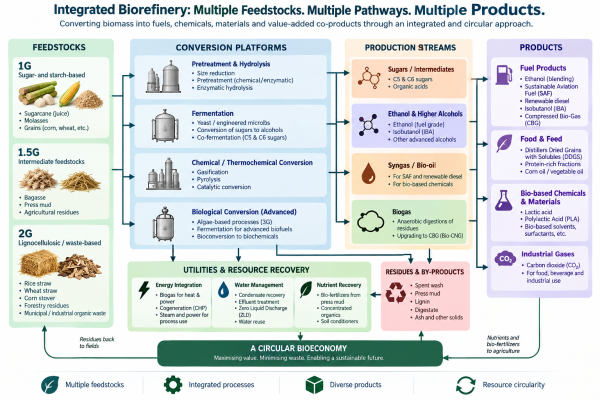
The integrated biorefinery model treats biomass as a portfolio of resources rather than simply as feedstock for ethanol. Different feedstocks, conversion technologies and downstream processes can be integrated to generate multiple products, recover resources and create greater value from the same biomass base.
- Zero Liquid Discharge (ZLD) systems enable greater recovery and reuse of process water and condensates. CPCB’s 2023 monitoring reported 4.7 litres of freshwater per litre of alcohol, down from 15 litres in 2016–17—a reduction of about 66%.
- Over the same period, specific spent-wash generation fell by about 41%, reflecting improvements in fermentation, distillation, evaporation and condensate-recovery systems.
- 1G, 1.5G and 2G pathways can integrate sugarcane, molasses, grains and lignocellulosic residues for greater feedstock flexibility.
- Depending on the configuration, outputs can extend well beyond ethanol to include distillers grains, carbon dioxide (CO₂), corn oil, protein-rich fractions, isobutanol, Sustainable Aviation Fuel (SAF) and Polylactic Acid (PLA). This creates opportunities to extract value from both the primary product stream and the carbon, nutrient and material fractions associated with the feedstock.
- Sustainable Aviation Fuel (SAF) can be produced through advanced alcohol-to-jet pathways, creating a route for ethanol-derived carbon to enter the aviation-fuel value chain.
- Isobutanol (IBA) represents another higher-value alcohol pathway, with potential applications as a fuel component, chemical intermediate and feedstock for further conversion.
- Polylactic Acid (PLA) can be produced by converting biomass-derived sugars into lactic acid and subsequently into a bio-based polymer, opening a materials pathway alongside fuels.
- Residue-to-CBG pathways are becoming an important part of the integrated biorefinery model: suitable residues and organic streams can undergo anaerobic digestion to produce biogas, containing typically 55–65% methane, which can be used for heat and power or upgraded to around 98% methane for Compressed Bio-Gas (CBG). SATAT (Sustainable Alternative Towards Affordable Transportation), launched in 2018, established an organised CBG ecosystem through long-term offtake arrangements with oil and gas marketing companies. This ecosystem has now reached 217 commissioned CBG plants as of August 2026, with 1,908 plants registered on the national GOBARdhan portal. With the CBG blending obligation currently set at 3% in FY 2026–27, 4% in FY 2027–28 and 5% from FY 2028–29 onwards in the CNG (Transport) and PNG (Domestic) segments, the expanding ecosystem creates further scope for integrating waste, energy, fuel and resource-recovery pathways within the biorefinery model.
- The focus shifts from litres of ethanol per tonne of feedstock to the total value of products, energy and recoverable resources generated from the same biomass.
For a distillery, this creates an opportunity to convert suitable residue streams into energy, fuel and additional revenue, while reducing the burden of waste management. The broader objective is to connect the plant’s material, energy and resource streams so that one process output can increasingly become the input or value stream for another.
Measuring Total Resource Value
This points to a broader measure of distillery performance. Ethanol yield will remain critical, but the integrated biorefinery must also measure value recovered per tonne of biomass, energy use, co-product realisation, residue utilisation and process-stream management. With sugarcane contributing around 30–35% of India’s ethanol requirement and sugar mills typically operating for only 3–5 months a year, feedstock flexibility and asset utilisation will become increasingly important. The goal, however, is not to add every possible technology, but to integrate the right combination of processes for each plant’s feedstock, energy, water, infrastructure and market conditions. The distillery of the future can therefore be seen as a resource-conversion platform—one that goes beyond ethanol to extract greater value from the entire biomass system.