info@thecatalystsgroup.com


 GET IN TOUCH
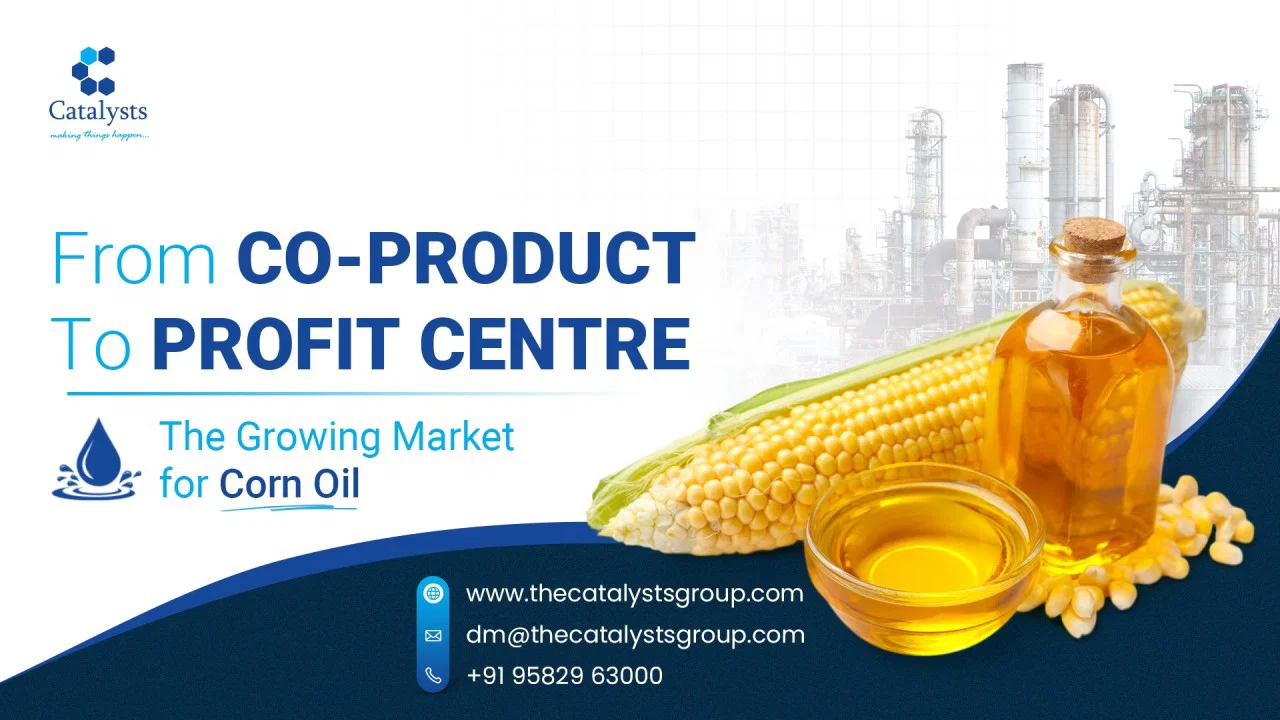
For many years, grain ethanol plants viewed corn oil as a secondary output of the production process.
Today, that perception is changing. As ethanol margins become increasingly sensitive to feedstock costs and market fluctuations, producers are looking beyond ethanol yield to improve plant profitability. One area receiving growing attention is corn oil, a co-product that has evolved into an important commercial commodity with applications across multiple industries.
More Than Just a By-Product
Corn contains approximately 3.5–4.5% oil, most of which is concentrated in the germ. During dry-grind ethanol production, this oil becomes available for recovery after fermentation and solids separation.
What was once considered a residual stream is now recognised as an additional source of revenue, contributing to the overall economics of grain ethanol production.
For many plants, efficient corn oil recovery has become an important part of improving profitability alongside ethanol and DDGS.
Where Does Corn Oil Go?
The value of corn oil lies in its versatility.
Recovered corn oil is used across several industries, including:
- Renewable Diesel and Biodiesel: One of the fastest-growing applications, driven by increasing demand for low-carbon transportation fuels.
- Animal Nutrition: Used as a high-energy ingredient in poultry, cattle, and aquaculture feed.
- Oleochemicals: Processed into fatty acids, surfactants, lubricants, and industrial chemicals.
- Industrial Manufacturing: Used in products such as soaps, coatings, emulsifiers, and specialty formulations.
As demand from these industries continues to grow, corn oil has become a commercially important co-product rather than simply a by-product of ethanol manufacturing.
Maximising Value Begins Inside the Plant
Recovering more corn oil is not simply about installing an oil separator.
The amount of recoverable oil is influenced by several upstream process variables, including:
- Grain quality
- Milling efficiency
- Liquefaction performance
- Fermentation stability
- Mash viscosity
- Solids separation efficiency
These factors determine how effectively oil is released from the grain matrix and made available for recovery.
Plants that optimize these process conditions are often able to improve both ethanol production and co-product recovery simultaneously.
Looking at the Entire Value Chain
Modern grain ethanol plants are no longer evaluated solely on litres of ethanol produced.
Today, they generate value from multiple product streams, including:
- Ethanol
- DDGS
- Corn Oil
- Carbon Dioxide (where recovery systems are installed)
This shift has changed how plant performance is measured.
Instead of focusing on a single output, producers are increasingly adopting an integrated approach that maximises the value of every component of the grain kernel.
Looking Ahead
As grain ethanol production continues to evolve,corn oil is becoming an increasingly important contributor to overall plant profitability.
The opportunity lies not only in recovering more oil, but in building processes that consistently maximise the value of every co-product alongside ethanol production.
At The Catalysts Group, we believe operational excellence extends beyond ethanol yield. Through biotechnology-driven process optimisation and technical expertise, we help grain ethanol plants improve process efficiency, strengthen co-product recovery, and maximise overall plant performance.
References
- Renewable Fuels Association (RFA). (2018). Fuel Ethanol Industry Guidelines, Specifications and Procedures. Renewable Fuels Association, Washington, D.C., USA. (Industry Technical Guideline). https://ethanolrfa.org/file/1989/Fuel-Ethanol-Industry-Guidelines-Specifications-2018.pdf
- United States Department of Agriculture, Agricultural Research Service (USDA-ARS). (2012). Moreau, R. A., Johnston, D. B., Haas, M. J., & Hicks, K. B. Aqueous Extraction of Corn Oil After Fermentation in the Dry Grind Ethanol Process. In Green Oil Processing (Book Chapter), AOCS Press, Urbana, Illinois, pp. 53-70. https://www.ars.usda.gov/research/publications/publication/?seqNo115=275127
- Kim, Y., Mosier, N. S., Hendrickson, R., Ezeji, T., Blaschek, H., Dien, B. S., Cotta, M. A., Dale, B. E., & Ladisch, M. R. (2008). Composition of Corn Dry-Grind Ethanol By-Products: DDGS, Wet Cake, and Thin Stillage. Bioresource Technology, 99(12), 5165-5176. https://doi.org/10.1016/j.biortech.2007.09.028
- Bothast, R. J., & Schlicher, M. A. (2005). Biotechnological Processes for Conversion of Corn into Ethanol. Applied Microbiology and Biotechnology, 67(1), 19-25. https://doi.org/10.1007/s00253-004-1819-8