
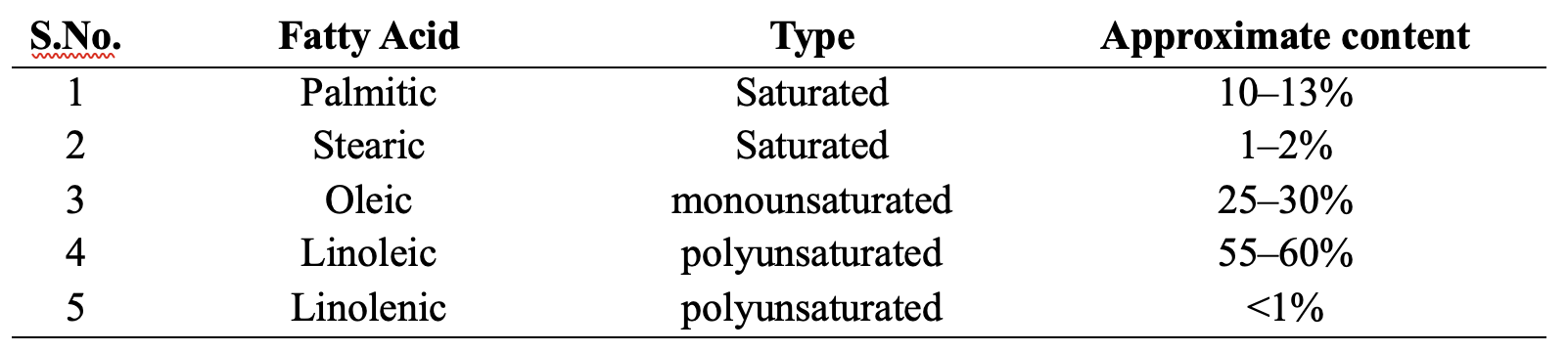
GC-FID (Gas Chromatography with Flame Ionisation Detector) has been widely used to determine the fatty acid composition of corn oil. Fatty acids are the major component of lipids, and the physical, chemical, and physiological properties of a lipid class depend primarily on its fatty acid composition (Table-1). The fatty acid composition is determined as Fatty Acids Methyl Esters of (FAMEs) by gas-liquid chromatography (GC)1,2
The triglyceride (TG) in the oil is esterified by using an alkylation derivatization reagent (sodium methoxide) because fatty acids present in oils may be difficult to analyse in their free state due to their high polarity and formation of hydrogen bonds that consequently result in adsorption problems. Before the fatty acid composition of a lipid can be analysed by gas chromatography, the lipid must be converted to low molecular weight, volatile, nonpolar derivatives i.e. methyl esters. This conversion usually is through transesterification – the glycerol (sugar alcohol) portion of the triglyceride (ester) is displaced by another alcohol, in the presence of an acid. The reaction is represented by the general equation (Figure-1). Hence, methylation reduces fatty acids' polarity and methyl esters offer better stability and quick quantitative samples for gas chromatography analyses.
Table -1 Major fatty acids present in corn oil
Extraction Method - Prior to GC-analysis, the corn oil is converted into FAME,s which includes several steps-
Step-1 Lipid Extraction – Extraction of oil using Soxhlet extraction, hexane, or another nonpolar solvent.
Step-2 Transesterification to FAMEs- (Base Catalysed) (Figure-1)
1. Add a known volume of corn oil (~50 mg) to a small round bottom flask.
2. Add methanolic KOH (0.5 M) which is act as catalyst.
3. Heat the extract at 60–70°C for 10–20 minutes.
4. So, the Reaction will convert triglycerides into Fatty Acid Methyl Esters.
Step-3 Extraction of FAMEs-
1. After transesterification, add hexane or heptane to extract the FAMEs.
2. Add water to separate phases.
3. Collect the organic layer, which contains the FAMEs.
4. Dry over anhydrous sodium sulphate to remove moisture.
5. Filter and transfer to a GC vial.
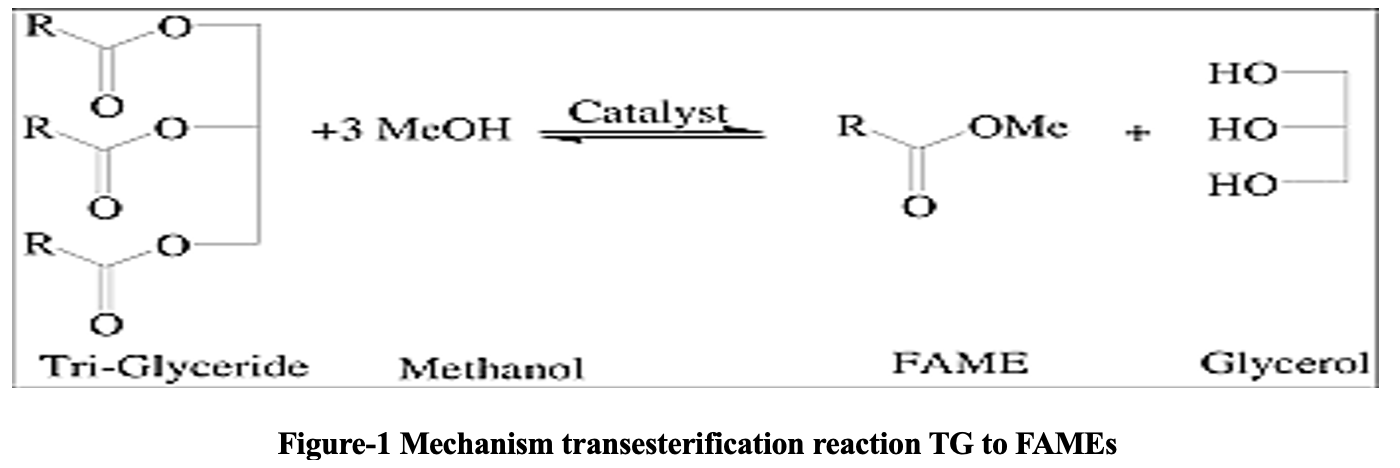
Table -2 Parameter used for FAMEs Analysis by GC-FID1
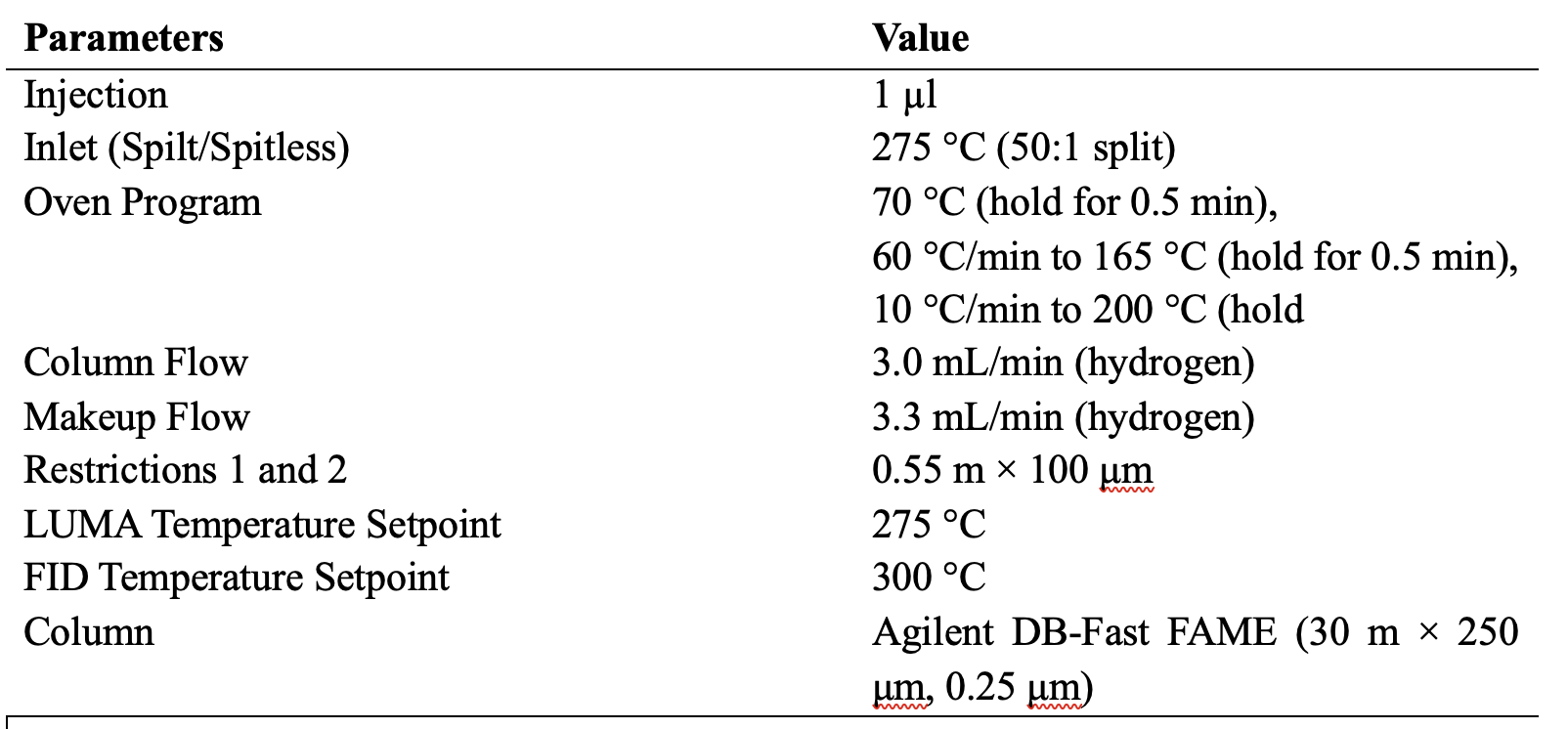
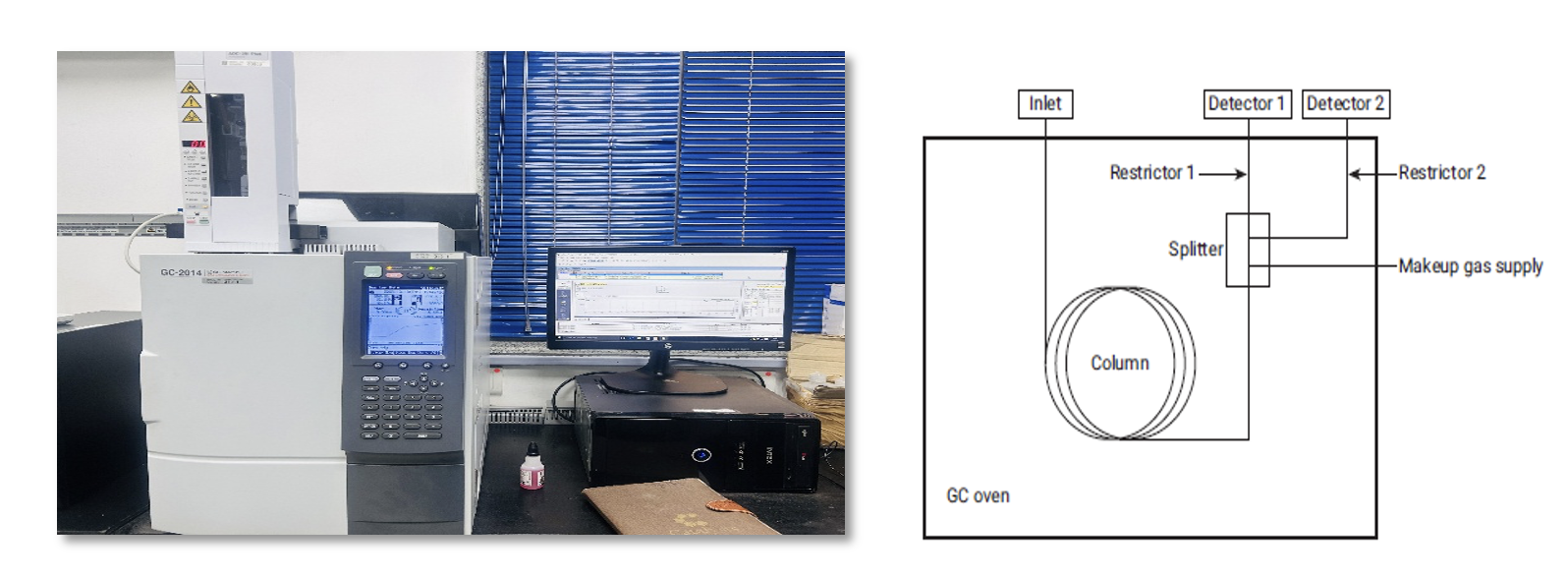
Figure-2 GC-FID and its configuration used for FAMEs analysis
Conclusion:
GC-FID analysis of Fatty Acid Methyl Esters (FAMEs) is essential for accurately determining the fatty acid composition of corn oil. This analysis is important for ensuring nutritional quality, maintaining product consistency, detecting adulteration, and meeting with other regulatory standards. Instead of that, biodiesel production, GC-FAME analysis is vital for evaluating fuel quality and transesterification efficiency. By converting fatty acids to their methyl ester forms, GC-FID allows precise, reliable, and reproducible profiling of corn oil’s fatty acid content, making it an important tool in both food and industrial applications
References:
- Sheppard A. J., Iverson J. L. 1975. Esterification of fatty acids for gas-liquid chromatographic analysis. J. Chromatogr. Sci. 13: 448–452.
- Christie W. W. 2003. Lipid Analysis. 3rd edition The Oily Press, Bridgwater, UK
Recent Posts
-1775236236.png)
CO2 Recovery & Monetization in Ethanol Plants
Discover innovative CO2 recovery and monetization strategies for ethanol plants, enhancing sustainability and profitability in the biofuel industry.
Rapid Corn Oil Estimation with Near-Infrared Spectroscopy: An Effective Analytical Technique with Ne
Explore the effectiveness of near-infrared spectroscopy in rapidly estimating corn oil, providing new perspectives and enhancing analytical techniques in agriculture.
The Role of Enzymes in Maize-to-Ethanol Fermentation
With the rising demand for renewable energy sources and sustainable fuel alternatives, ethanol production has gained significant momentum worldwide. Ethanol, also known as bioethanol, is a biofuel commonly used as a renewable alternative to fossil fuels. One of the most popular feedstocks for ethanol production is maize (corn), primarily due to its high starch content, wide availability, and suitability for large-scale production.
Catalysts Connect
Keep up to date with our latest news and analysis by subscribing to our regular magazine and newsletter
Post a comment
Your email address will not be published.